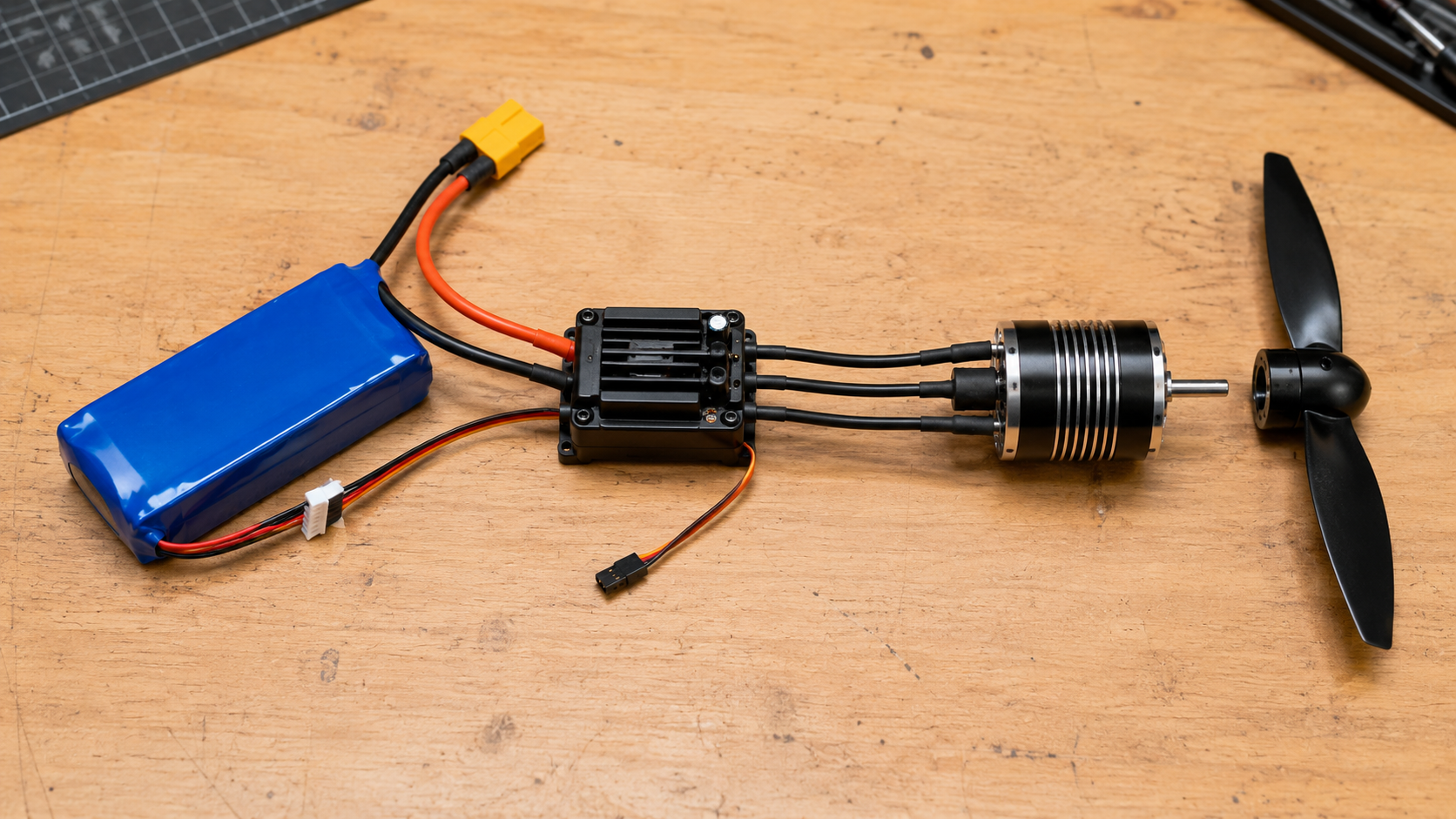
An electric RC power system can look deceptively simple. Connect a battery to an electronic speed controller, attach the ESC to a motor, bolt on a propeller, and advance the throttle. What could go wrong?
Plenty.
A motor that seems ideal on paper may overheat when paired with the wrong propeller. A generously sized ESC may still fail if its cooling is poor. A battery with enough voltage may sag badly because its current rating is inadequate. Even a small propeller change can push an otherwise reliable system beyond its limits.
The secret is to stop thinking of the motor, propeller, ESC, and battery as separate components. They form one interconnected power system. Change one part, and the operating conditions of every other part may change with it.
A successful electric setup is not simply powerful. It is balanced, measurable, and appropriate for the airplane.
Start With the Airplane
Before selecting a motor, determine what the airplane actually needs.
Consider its ready-to-fly weight, wing area, aerodynamic drag, intended flying style, and available space for the battery and power system. A lightly loaded trainer has very different requirements from a fast sport model, a scale warbird, or a 3D aerobatic airplane.
Watts per pound provides a useful starting point:
- 50 to 75 watts per pound for gentle trainers and powered gliders
- 75 to 100 watts per pound for general sport flying
- 100 to 150 watts per pound for aerobatics and faster models
- 150 watts per pound or more for aggressive vertical performance and 3D flying
These figures are guidelines, not guarantees. A sleek airplane can fly quickly on modest power, while a draggy biplane may require considerably more wattage to achieve similar performance.
Suppose a six-pound sport airplane is intended to have strong aerobatic capability. At approximately 125 watts per pound, the power system should produce around 750 watts.
That number becomes the starting point for selecting the remaining components.
Understanding Motor Specifications
Brushless motors are commonly described by their physical size, weight, Kv rating, maximum current, and maximum power.
The Kv rating tells you approximately how many revolutions per minute the motor will attempt to turn for each volt applied under no-load conditions. A 900 Kv motor connected to a four-cell lithium-polymer battery with a nominal voltage of 14.8 volts has a theoretical no-load speed of about 13,300 rpm.
That does not mean the motor will reach that speed while turning a propeller. The propeller creates a load, reducing rpm and increasing current draw.
A higher Kv motor is not automatically more powerful. It simply tries to turn faster for a given voltage. High-Kv motors generally use smaller propellers, while lower-Kv motors can often turn larger propellers more efficiently.
Motor weight and physical size also matter. A tiny motor may advertise impressive peak wattage, but it may not be able to absorb or dissipate heat for more than a short burst. A larger motor operating comfortably below its maximum rating will often be more reliable than a smaller motor pushed to its limit.
Pay close attention to the manufacturer’s maximum current and power recommendations. These limits may vary depending on battery voltage, propeller size, cooling, and duration of operation.
Whenever possible, choose a motor with some reserve capacity. A system expected to produce 750 watts should not rely on a motor rated for exactly 750 watts under ideal conditions. A motor rated for 850 to 1,000 watts provides a more comfortable operating margin.
The Propeller Controls the Load
The propeller is one of the most influential parts of the entire system.
Propeller diameter primarily affects the volume of air moved and the load placed on the motor. Propeller pitch affects how far the propeller would theoretically advance through the air during one revolution.
Increasing either diameter or pitch generally increases current draw.
A 12 x 6 propeller and a 13 x 6 propeller may look similar, but the larger diameter can produce a substantial increase in electrical load. Changing from a two-blade propeller to a three-blade propeller can also increase load, even when the listed diameter and pitch appear comparable.
This is why propeller recommendations should never be treated casually. If a motor manufacturer recommends a 12 x 6 propeller on a four-cell battery, installing a 14 x 8 because it fits the cowling may overload the motor, ESC, and battery.
Propeller selection also shapes how the airplane feels.
A larger-diameter, lower-pitch propeller often produces strong static thrust, good acceleration, and effective low-speed pull. This can work well for trainers, aerobatic airplanes, and models that need short takeoff performance.
A smaller-diameter, higher-pitch propeller may produce greater pitch speed and suit faster aircraft, provided the motor can turn it efficiently.
The ideal propeller is not necessarily the one that produces the highest wattmeter reading. It is the one that provides the desired flight performance while keeping current, temperature, noise, and component stress within acceptable limits.
Choosing the Battery Voltage
Lithium-polymer batteries are identified partly by cell count. Each cell has a nominal voltage of approximately 3.7 volts.
A three-cell pack is rated at 11.1 volts nominal, a four-cell pack at 14.8 volts, and a six-cell pack at 22.2 volts.
Increasing voltage allows the system to produce the same power at lower current.
Because electrical power is calculated by multiplying voltage by current, a 600-watt system operating at 12 volts requires roughly 50 amps. The same 600 watts at 24 volts requires only about 25 amps.
Lower current can reduce losses in wires, connectors, the ESC, and the battery. This is one reason larger electric models commonly use higher-voltage battery systems.
However, increasing cell count also raises motor rpm. The motor’s Kv rating and propeller size must therefore be appropriate for the selected voltage.
A motor that works well on three cells may draw excessive current or overspeed when connected to four cells with the same propeller. The propeller may need to be reduced in diameter, pitch, or both.
Voltage, Kv, and propeller size must always be considered together.
Battery Capacity and Discharge Capability
Battery capacity is measured in milliamp-hours. A 5,000 mAh battery has a nominal capacity of 5 amp-hours.
Capacity influences flight time, battery weight, and the amount of current the pack can theoretically supply.
The discharge rating, expressed as a C rating, estimates the battery’s current capability. A 5,000 mAh battery rated at 30C theoretically supports:
5 amp-hours × 30C = 150 amps
In practice, C ratings should be treated cautiously. Testing standards are not always consistent, and a battery operated near its advertised maximum may experience voltage sag, excessive heat, shortened service life, or swelling.
A battery should provide comfortable current headroom. If the power system draws 60 amps at full throttle, a quality pack capable of delivering substantially more than 60 amps is preferable.
Connector quality, wire size, pack age, temperature, and internal resistance also affect performance. A battery that worked well two seasons ago may sag noticeably today, even though its label has not changed.
After a flight, the battery should be warm at most, not uncomfortably hot. Excessive temperature is a warning that the pack may be overloaded, damaged, poorly cooled, or nearing the end of its useful life.
Sizing the ESC
The ESC must handle the system’s voltage and current while providing reliable throttle control.
Its voltage rating must support the battery cell count. An ESC rated for three or four cells should not be used on a six-cell pack.
Its continuous current rating should exceed the measured full-throttle current. If the power system draws 52 amps, selecting a 60-amp ESC may appear acceptable, but it offers limited margin. A 70- or 80-amp ESC may be a better choice, particularly in a tightly cowled airplane or a model flown frequently at high power.
Burst ratings apply only for short periods and should not be used as the normal operating target.
Cooling is equally important. An ESC buried beneath foam, wiring, or a battery can overheat even when current remains below its advertised rating. Position it where cooling air can reach the heat sink, and provide an exit path so warm air can leave the fuselage.
Also check the battery eliminator circuit, or BEC. Digital servos, retracts, lighting systems, and multiple control surfaces can place significant demands on the receiver power supply. A large model may require a high-current switching BEC, a separate receiver battery, or a dedicated power-management system.
The Wattmeter Settles the Argument
Manufacturer charts, online calculators, and experience are useful, but they cannot account for every variable.
Propeller brand, battery condition, connector resistance, motor timing, altitude, temperature, and airflow can all change the result.
A wattmeter provides the real numbers.
Install the intended battery and propeller, secure the airplane, and measure voltage, current, and power at full throttle. Use extreme caution around the propeller. Keep people, loose clothing, tools, and wires clear of the propeller arc.
Compare the measured current and wattage against the limits of the motor, ESC, and battery.
If current is too high, reduce propeller diameter or pitch. If power is too low, a slightly larger propeller may help, provided all component limits are respected. Make one change at a time and test again.
Static testing should be followed by temperature checks. Run the system for a realistic period, then inspect the motor, ESC, battery, connectors, and wiring. Components that become excessively hot are signaling a problem, even if the wattmeter numbers appear acceptable.
Build in Breathing Room
A reliable power system should not operate at the edge of every published limit.
Measurements can change as battery voltage rises immediately after charging. Propellers may vary between manufacturers. Cooling may be less effective during a long vertical climb than it was during a short bench test.
Allowing approximately 15 to 25 percent operating margin is a sensible practice for many sport models. Greater margins may be appropriate for scale aircraft, enclosed installations, hot-weather flying, or models expected to spend long periods at high throttle.
The goal is not to install the largest possible motor, battery, or ESC. Oversized components add weight, and weight increases the power required to fly.
The best system is appropriately sized, efficiently propped, properly cooled, and comfortably within its limits.
A Practical Matching Sequence
A dependable selection process follows a logical order:
- Determine the airplane’s flying weight and desired performance.
- Estimate the required wattage.
- Choose a suitable battery voltage.
- Select a motor with the appropriate Kv and power capacity.
- Select an ESC with adequate voltage, current, and BEC ratings.
- Choose a conservative propeller from the motor manufacturer’s recommendations.
- Test the complete system with a wattmeter.
- Check temperatures and adjust the propeller as necessary.
- Repeat the test whenever the battery voltage, motor, propeller, or ESC changes.
This method replaces guesswork with controlled experimentation.
The Reward of a Balanced System
A well-matched electric power system does more than protect expensive components. It improves the entire flying experience.
The airplane accelerates cleanly, maintains power through maneuvers, and delivers predictable flight times. The battery finishes the flight in good condition. The motor and ESC remain within safe temperatures. Throttle response feels smooth rather than strained.
Most importantly, the pilot can focus on flying instead of wondering whether the power system is moments away from shutting down.
Motors, propellers, ESCs, and batteries are not independent items selected from four separate shopping lists. They are partners in a single system.
Match them carefully, verify them with real measurements, provide adequate cooling, and leave room for the unexpected. When every component is working comfortably with the others, reliable electric power becomes far less mysterious and much more enjoyable.
Have Questions?
Contact us about visiting the field, learning to fly, upcoming events, or club membership. We look forward to connecting with you.