Club History
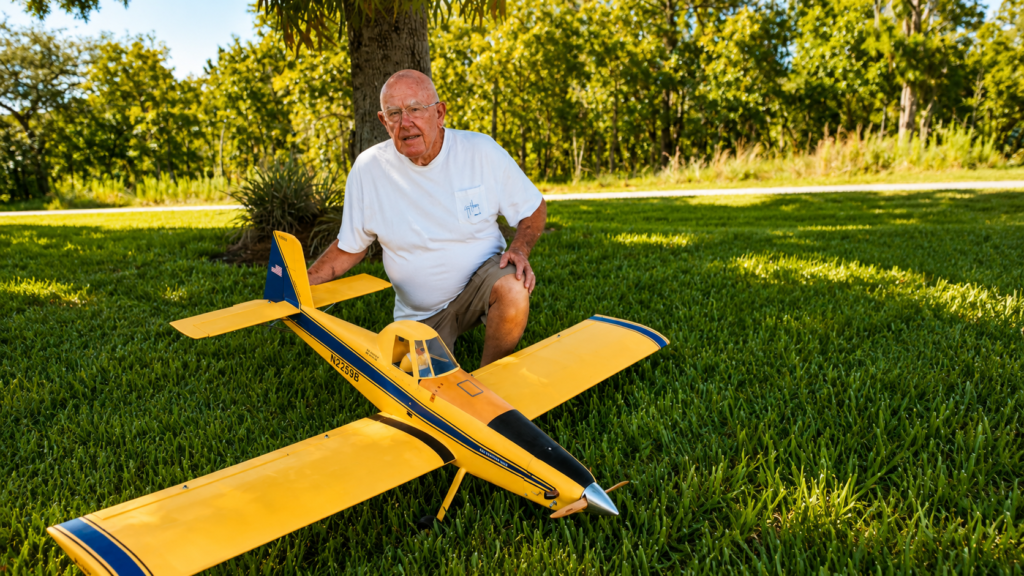
In Memory of Dave Small
The following article was originally submitted by Louis D. Lopez. It has been updated to better reflect where we are today.
We now have many new members who may not be familiar with how the club was originally formed. It all started with an advertisement placed in a small weekly newspaper in Inverness, Florida, in the early 1980s. Louis Lopez felt there should be an RC club in the area and began the discovery process. Because he was new to the area himself, the challenge was even more difficult. He began asking questions and published the advertisement mentioned above.
He simply asked the general public, “Anyone interested in radio-controlled planes and boats, give me a call.” Several local people had advised him that this approach would not work because it had been tried before.
Being Louis, he could not believe or accept this negative feedback, so he continued moving forward. Almost immediately, he received four calls. A meeting was scheduled, and the club was formed.
It was exceedingly difficult at first, but he had a small group of interested people, and the club grew from there. Today, the club is almost 40 years old. It was originally established as the Citrus County RC Club. That name is still maintained as the corporate name, but it is no longer the operating name. The DBA today is “Tri-County RC Club” because we are now located in Marion County, and it seemed like the right thing to do.
The club used four flying sites before arriving at its current location. One site lasted for only one week, while others were used for several months or a few years. One field in Citrus Hills was located within a housing development where the developer had installed miles of streets, but it took a long time for any houses to be built.
The conditions were marginal at best. Members parked just off the runway, there were no safety fences, and no frequency-control system was available for radio transmitters. Transmitters used AM technology back then, and there were many radio interference incidents and hard landings. Batteries were not what they are today, and accidents were often caused by people testing their batteries before a flight. Technology has made enormous strides since those early days.
The field was moved to a cow pasture in Lecanto, Florida, around 1988. Again, there were no safety fences, transmitter boards to track who was flying on a particular frequency, or setup tables. There were many cow patties to avoid during takeoffs and landings, and on some days, members first had to clear a runway.
The current site covers approximately 30 acres and is located in the City of Dunnellon in Marion County, Florida. The Dunnellon site was secured through the persistence and continuous networking efforts of Don Adkins, Ted Hessler, Doug Hummer, Tom Marr, and several other members.
One meeting eventually led to a connection with Mr. Fred Ayer, Director of the Office of Greenways and Trails. Louis later received a letter informing him that the Greenways office would do everything possible to assist the club. After receiving additional information about the club’s needs, Fred Ayer promised to investigate whether suitable land was available.
The dialogue continued for another 18 months because the Office of Greenways and Trails is responsible for thousands of acres of land throughout the State of Florida.
Originally federal land during the Nixon administration, this portion of Greenways property was scheduled to be used for the Florida Barge Canal. The project was canceled because of environmental concerns, and the land was then given to the State of Florida to be used exclusively for recreation. Establishing a location for an RC aircraft club became a great fit.
Further approvals were required from Marion County and the City of Dunnellon. The entire process took several years, many letters, and numerous meetings, but it was worth the effort.
Around 1989, the Cook Shack and Club Shack were constructed first, with all the work completed by club members. Safety fencing followed and was later upgraded. Dr. Ralph Rogers and Les Watson built most, if not all, of the current tables.
The first fabric runway was installed around 2009 and replaced three years later. An upgraded material was subsequently installed and remains in use today. The East and West Pavilions were added in 2010, with significant support from George Derewenko and Chris Wieland. Chain-link fencing added the finishing touches soon afterward. Walt Graves spearheaded the electrification of the pavilions in May 2013.
The Office of Greenways and Trails has been pleased with how the club has cared for the property. This has created a mutually beneficial relationship and serves as a key motivation for those who continue to maintain the site.
The signs at the gate are special. The painted sign on the left as you enter was purchased by the club. The carved wooden sign on the right was given to the club by the State of Florida.
Louis expressed it well when he said, “The Florida Department of Environmental Protection’s Office of Greenways and Trails has treated us well. What can I say? I can’t find the words to express my appreciation.”
This remains true to this day.
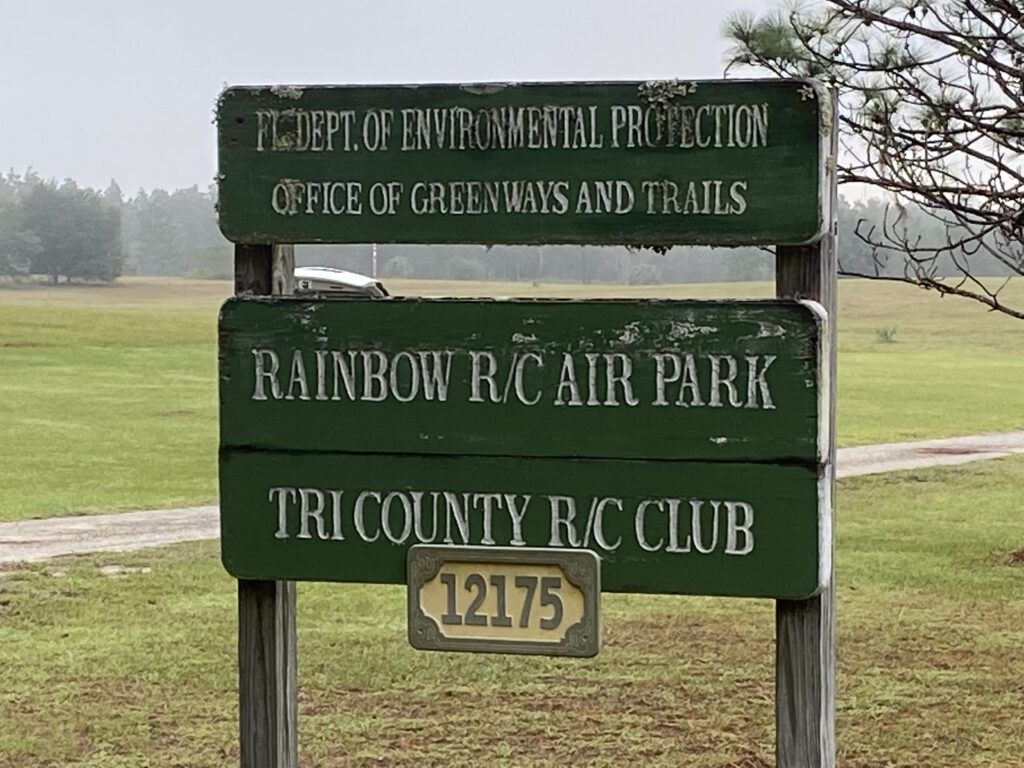
Thank You, Office of Greenways and Trails
Last updated in October 2020 by Rick Loveless, with additional feedback from many members.
Have Questions?
Contact us about visiting the field, learning to fly, upcoming events, or club membership. We look forward to connecting with you.