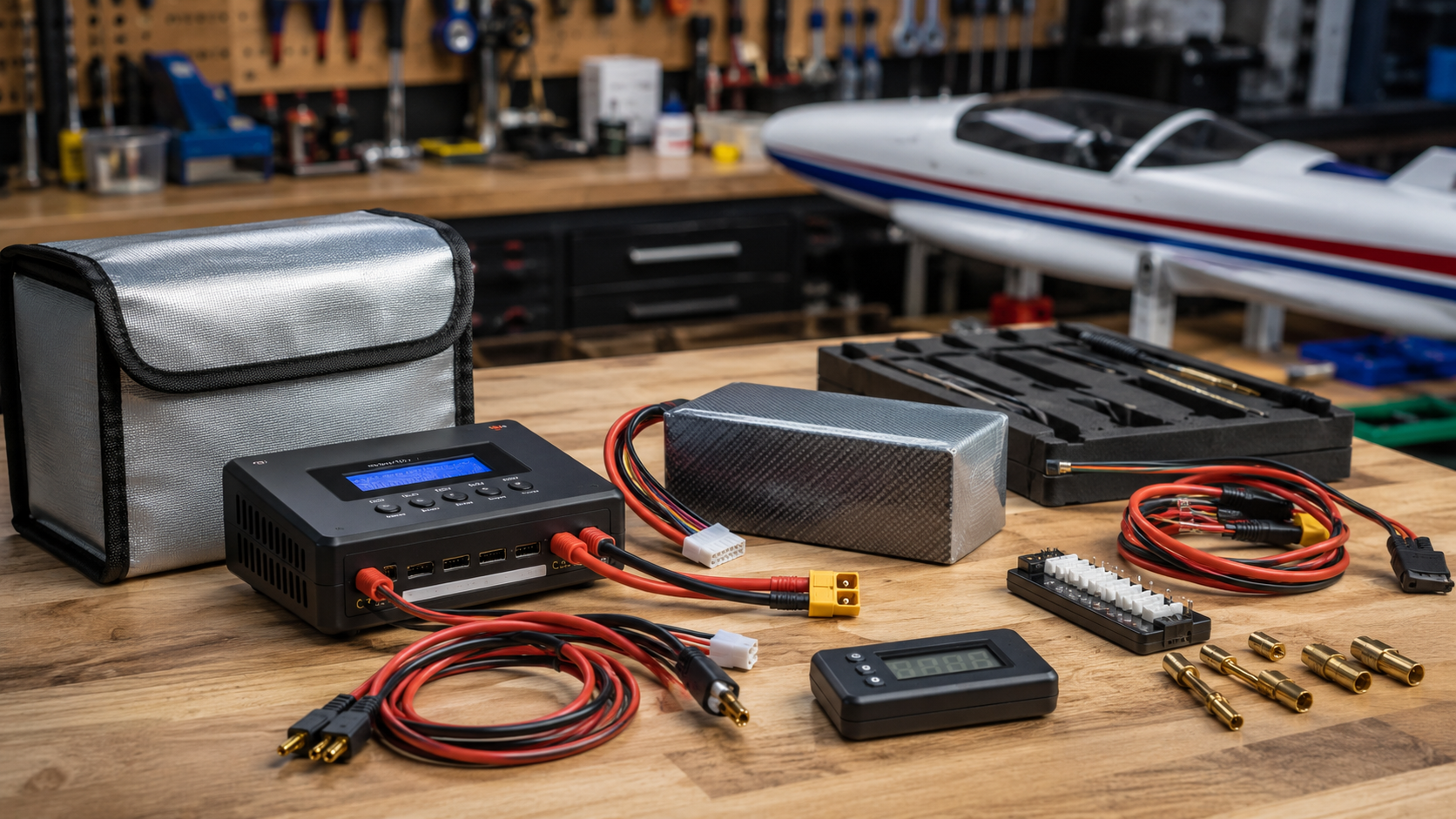
Most RC pilots learn the first layer of LiPo safety quickly: use a balance charger, select the correct cell count, never charge unattended, and protect the pack from punctures. Those rules matter, but they are only the beginning. Long service life and dependable performance come from understanding what happens every time a battery is charged, stored, installed, flown, and allowed to cool.
A LiPo rarely becomes tired because of one dramatic mistake. More often, it is weakened by a series of small ones. It sits fully charged for several days. It is flown while warm from charging. It is discharged slightly too far. It is recharged before cooling. None of these choices may cause an immediate failure, but together they raise internal resistance, reduce capacity, upset cell balance, and shorten useful life.
Advanced battery care is not complicated. It is consistent.
The Four Enemies of Battery Life
Every LiPo ages, even when treated well. The goal is not to stop aging, but to slow it. Four factors do most of the damage: heat, high voltage, low voltage, and physical stress.
Heat is the clearest warning sign. A pack that finishes a flight mildly warm may be operating normally. A battery that is uncomfortably hot is telling you something needs attention. The propeller may be too large, the power system overloaded, cooling poor, the battery undersized, or the pack already weakened.
High voltage is quieter but equally important. A conventional LiPo cell reaches full charge at 4.20 volts. The longer it remains near that level, the faster it ages. Charging shortly before flying is easier on the battery than charging days in advance.
Low voltage creates a different kind of stress. Voltage falls under load, and the weakest cell can dip too far even when total pack voltage appears acceptable. Repeated deep discharges increase resistance and reduce capacity.
Physical stress includes crashes, overtightened straps, vibration, damaged leads, crushed corners, and batteries sliding inside the model. A pack may look normal while hiding a compromised pouch or connection.
Make Storage Voltage the Default
The most useful habit beyond basic charging is to treat storage voltage as the battery’s normal resting condition.
For most standard LiPo packs, storage voltage is approximately 3.75 to 3.85 volts per cell. Most chargers target about 3.80 or 3.85 volts. At this level, the pack is neither full nor deeply discharged, reducing chemical stress.
Storage mode is not just for winter. It is appropriate whenever a battery will sit unused for more than a day or two. When weather cancels a flying session and several packs are still full, use the charger’s storage program rather than leaving them at 4.20 volts per cell until the following weekend.
After flying, let the pack cool before placing it into storage mode. Keep batteries in a cool, dry, temperature-stable location away from combustible materials. Avoid hot vehicles, direct sunlight, damp sheds, and places where condensation may form.
A LiPo safety bag adds protection, but it does not make poor storage practices safe. The surrounding area should still be noncombustible and separated from fuel, paper, fabric, and other easily ignited materials.
Charge for Longevity, Not Just Speed
A 1C charge rate remains a sensible routine for many packs. At 1C, a 5,000 mAh battery is charged at 5 amps. Some batteries advertise higher charge rates, but faster charging produces more heat and can accelerate wear. Use higher rates only when the manufacturer permits them and field turnaround truly requires them.
Balance charging should be the normal method. The balance connector allows the charger to monitor each cell and correct small differences near the end of the charge.
Before starting, confirm the battery chemistry, detected cell count, capacity, and current. During charging, check for swelling, unusual warmth, odor, damaged wiring, or rapidly increasing cell imbalance.
Allow batteries to cool before charging. Recharging immediately after a demanding flight stacks one heat cycle on another and makes voltage readings less meaningful.
Parallel charging can be efficient, but it requires discipline. Packs should have the same cell count, similar voltage, compatible capacity, and healthy connectors. A damaged or badly mismatched battery does not belong on a parallel board.
Read the Numbers as Trends
A charger display can reveal whether the cells are behaving as a matched group.
Small voltage differences are normal during charging. What matters is whether the pack repeatedly finishes with one cell lagging behind, rising unusually fast, or requiring excessive time to balance. One odd reading may be caused by temperature or a connector issue. A repeated pattern deserves attention.
Internal resistance is also useful when treated as a trend rather than a universal score. As resistance increases, the battery produces more heat and suffers greater voltage sag. The result is less punch, shorter flight time, and more stress on the weakest cell.
Resistance readings vary among chargers, so compare the same pack using the same charger at similar temperatures. Look for changes over time and differences among cells. One cell that consistently measures much higher than the others may be developing a problem.
Fly the Battery, Not Just the Timer
Flight timers should be based on measured consumption.
After a typical flight, note how many milliamp-hours the charger returns to the battery. A practical routine is to use roughly 70 to 80 percent of rated capacity, leaving a reserve. If a 5,000 mAh pack regularly accepts about 3,500 to 4,000 mAh after a flight, the timer is probably in a reasonable range.
This is safer than flying until the low-voltage cutoff reduces power. The cutoff is a protective last resort, not a normal landing signal.
Throttle style also matters. Repeated full-power climbs, extended high-speed passes, hovering, aggressive 3D flying, and oversized propellers create heavy current demand. Two pilots can use the same airplane and battery yet return with very different pack temperatures.
Check the battery immediately after landing. Note its temperature, firmness, and cell voltage. A pack that suddenly comes down hotter, softer, more swollen, or more unbalanced than usual is giving you an early warning.
Respect the Installation
Battery care continues inside the airplane.
Secure the pack against movement without crushing it. Overtightened straps can damage pouch cells, especially when the battery rests against a hard tray edge. Add a smooth protective surface or thin padding where needed.
Keep batteries away from screws, pushrods, servo arms, rough wood, and composite edges. Route wires so they cannot rub against structure or contact a rotating motor can. Provide airflow when the power system operates near the battery’s continuous capability.
Inspect connectors regularly. Loose bullets, darkened contacts, softened housings, frayed insulation, and weak solder joints create resistance and heat. A connector that becomes hot during normal operation may be limiting performance or creating a failure point.
Grip connector housings rather than pulling on wires. Protect balance leads from propellers, landing gear, and battery straps.
Manage the Fleet
Number each battery and record its purchase date, capacity, cell count, connector type, and assigned models. A simple log can also track cycles, recharge amounts, unusual temperatures, internal resistance, repairs, and performance changes.
A label and a few notes are enough to reveal that Battery 4 always comes down hotter or Battery 7 takes longer to balance. Without identification, weak packs disappear into the fleet and keep returning to service.
Rotate batteries rather than always using the newest one first. Match packs used in series by age, capacity, condition, and charge state. In a series setup, the weaker battery limits the entire system.
A pack that no longer suits a high-current EDF may still serve in a lower-demand trainer, provided it remains physically sound and electrically stable. Downgrading a pack should never excuse swelling, damage, or an unstable cell.
Know When to Retire It
Remove a battery from service when it shows persistent swelling, physical damage, electrolyte odor, unusual self-discharge, severe imbalance, excessive heat, damaged wiring, or major capacity loss.
Even mild puffing is a warning. Swelling means gas has formed inside the pouch, and the pack no longer has its original safety margin.
Isolate retired batteries so they cannot be used accidentally. Cover exposed connectors, store them in a fire-resistant location, and follow the manufacturer’s instructions and local hazardous-waste requirements. Do not puncture, crush, burn, or place a damaged LiPo in household trash.
Build a Repeatable Routine
Before flying, inspect the pack, confirm cell balance, check the connector, and make sure the battery is cool. After landing, note temperature and remaining voltage. Identify any pack that behaved differently. At home, return unused or partially used batteries to storage voltage and periodically review connector condition, resistance trends, and recharge capacity.
The reward is more than longer battery life. A well-managed battery fleet delivers steadier power, predictable flight times, fewer surprise cutoffs, and greater confidence at the field.
LiPo batteries reward pilots who pay attention to small details. Charge them near the time of use. Store them correctly. Keep them cool. Avoid deep discharge. Track individual cells. Protect each pack from physical damage. Retire it when warning signs become clear.
That is LiPo care beyond the basics: disciplined energy management, one flight at a time.
Have Questions?
Contact us about visiting the field, learning to fly, upcoming events, or club membership. We look forward to connecting with you.