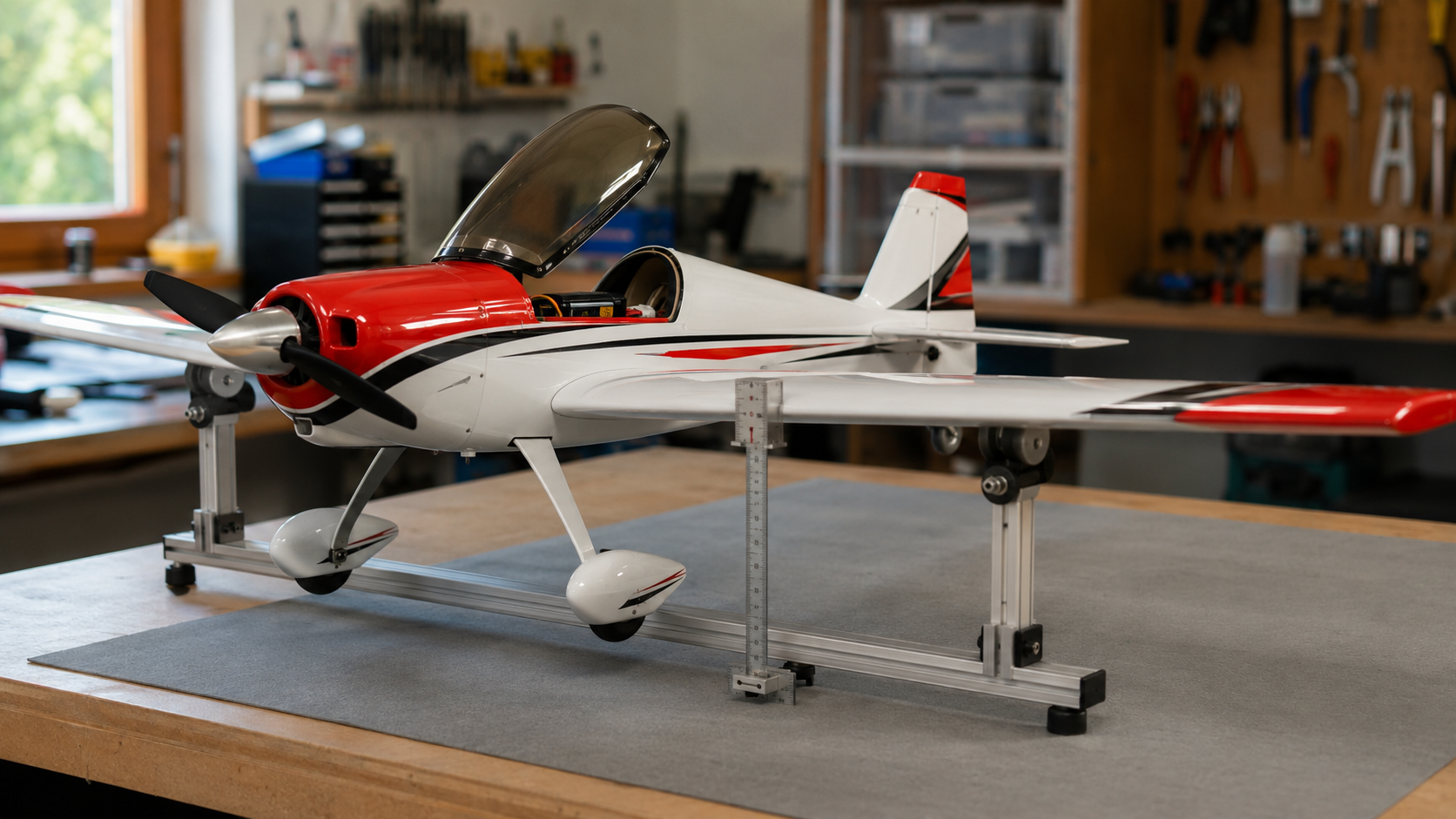
The airplane looks perfect on the flightline. The control surfaces move in the correct direction, the battery is charged, and the motor produces plenty of power. You advance the throttle, begin the takeoff roll, and lift away normally.
Then the model starts to feel strange.
It requires constant elevator correction. Turns tighten unexpectedly. The nose rises when power is applied, and the airplane refuses to settle into a comfortable rhythm. What should have been an ordinary flight becomes a tense exercise in keeping the wings level and the nose pointed somewhere near the horizon.
The problem may not be the radio, the servos, or the pilot.
It may be the center of gravity, and the difference between a pleasant airplane and a difficult one may be only a few millimeters.
The Airplane’s Balance Point
The center of gravity, commonly shortened to CG, is the point at which the airplane’s weight can be considered concentrated. Place the model on a balancing stand at that location, and it should rest without falling sharply forward or backward.
That description makes the CG sound like a simple workshop measurement, but its effect reaches into nearly every part of the airplane’s behavior.
The wing produces lift, while the horizontal stabilizer and elevator help control pitch. The center of gravity determines how the airplane responds when those forces change. A properly balanced model naturally resists unwanted pitch changes and gives the pilot time to recognize and correct disturbances.
Move the CG too far forward, and the airplane becomes excessively stable, heavy on the elevator, and reluctant to rotate. Move it too far backward, and the model becomes sensitive, unpredictable, and potentially uncontrollable.
The airplane may weigh exactly the same in both cases. Only the distribution of that weight has changed.
Nose-Heavy and Tail-Heavy Behavior
A nose-heavy airplane is often unpleasant, but it is usually manageable.
It may require additional up-elevator for takeoff. It may descend rapidly when power is reduced and feel as though it wants to drive toward the ground during landing. The elevator may seem weak, especially at low airspeed, and the model may need a faster approach to maintain control authority.
Pilots sometimes describe a nose-heavy aircraft as feeling solid. That solidity can be deceptive. Excessive forward balance increases the workload on the wing and tail, creates drag, and can make the model difficult to flare. A severely nose-heavy airplane may run out of elevator just when the pilot needs it most.
A tail-heavy model behaves differently.
Pitch response becomes increasingly sensitive. A small elevator input may produce a large attitude change. The airplane may wander in pitch, tighten its turns, or stall without much warning. Instead of naturally returning toward a stable attitude, it may continue moving away from it.
This is why the old saying remains useful: a nose-heavy airplane may fly poorly, but a tail-heavy airplane may fly only once.
That saying is not an excuse to place the CG as far forward as possible. It is a reminder that the safe side of an uncertain balance range is generally the forward side.
Why a Few Millimeters Matter
On a full-size airplane, a small movement may seem insignificant. On an RC model, however, a few millimeters can represent a meaningful portion of the permitted CG range.
Suppose a manufacturer recommends balancing a model between 70 and 80 millimeters behind the wing’s leading edge. Moving the CG from 72 to 78 millimeters may sound like a minor adjustment. In reality, it moves the airplane through most of its approved range.
The effect can be particularly noticeable in small models, short-coupled airplanes, swept-wing designs, and high-performance aerobatic aircraft. These models may respond dramatically to changes that would be less obvious on a large, lightly loaded trainer.
Battery placement is one of the most common causes of CG variation. A flight battery may shift slightly within a tray, or the pilot may install a different pack with the same cell count but a different weight or shape. A receiver battery, ignition module, pilot figure, spinner, or heavier propeller can also change the balance.
Repairs matter as well. A reinforced tail, replacement landing gear, additional paint, or a new engine can quietly move the CG. The airplane may look unchanged while its flight characteristics become entirely different.
Begin With the Published Specification
The manufacturer’s recommended CG should be the starting point for any new model.
Read the instructions carefully. Confirm whether the measurement is taken from the wing’s leading edge, a panel joint, the wing root, or another reference point. On tapered or swept wings, measuring at the wrong location can produce a significant error.
Do not assume that the thickest part of the wing, the main spar, or the center of the wing chord is automatically the correct balance point. Those locations may be close on some aircraft and completely wrong on others.
When the instructions provide a range, begin near the forward portion of that range. This normally gives the model greater pitch stability during its first flights. The CG can then be moved rearward gradually as the airplane is evaluated.
For an older model without reliable instructions, seek information from the designer, manufacturer, an experienced owner, or a trustworthy plan. Calculations based on wing geometry can provide an estimate, but an estimate should be treated conservatively until confirmed through flight testing.
Measure the Airplane as It Will Fly
A CG check is only meaningful when the airplane is prepared in flight-ready condition.
Install the correct battery, propeller, spinner, canopy, wing, landing gear, fuel tank, and accessories. A fuel-powered airplane should be checked according to the manufacturer’s instructions, usually with the tank empty or at a specified fuel level. Electric models should be balanced with the actual flight battery secured in its normal position.
Retracts should be placed in the recommended position. Large landing gear assemblies can influence balance when they move, particularly on scale models.
Mark the recommended CG location on both sides of the wing. Small pieces of low-tack tape can make the marks easy to find without permanently altering the covering.
The model can be balanced on fingertips, but a purpose-built balancing stand usually provides greater repeatability. Support the aircraft at the marked points and allow it to settle naturally. A slight nose-down attitude is often acceptable for an initial flight. A strong drop in either direction indicates that adjustment is needed.
Avoid pressing against the airplane or holding it in position. The purpose is to observe where the model wants to balance, not where the pilot can force it to remain.
Do Not Ignore Lateral Balance
Most CG discussions focus on the airplane’s fore-and-aft balance, but lateral balance also affects flight.
Support the model at the spinner or propeller shaft and at a point near the tail. Allow the airplane to hang freely. If one wing consistently drops, that side is heavier.
A slightly heavy wing may cause the airplane to roll more readily in one direction, require aileron trim, or behave differently during loops and vertical maneuvers. The effect is especially noticeable on aerobatic airplanes.
Whenever practical, move equipment to correct the imbalance. A receiver, speed controller, or battery lead may be repositioned. When relocation is impossible, a small amount of weight can be added near the lighter wingtip.
Let the Airplane Provide Evidence
Ground measurement establishes a safe starting point. Flight testing refines it.
Begin with ordinary observations. Note the amount of elevator trim required for level flight at a comfortable cruising speed. Observe how the airplane behaves when power is reduced. Watch whether turns remain smooth or tighten unexpectedly.
One common evaluation is the 45-degree dive test. At a safe altitude, establish level flight, reduce power as appropriate, and place the airplane in a moderate descending line. Gently release the elevator and observe the response.
A strongly nose-heavy airplane will often pull out of the dive quickly. A well-balanced sport model may gradually recover or maintain the line briefly before beginning to rise. A rearward-balanced airplane may remain in the dive or steepen it.
This test is useful, but it is not absolute. Elevator trim, wing incidence, thrust angle, airfoil design, and control setup can influence the result. It should be considered alongside the airplane’s overall behavior.
Experienced aerobatic pilots may also observe how much forward elevator is needed during inverted flight. An airplane that requires a large amount of forward pressure may have a forward CG. One that requires almost none may be balanced farther aft.
Again, the goal is not to chase a single test result. The goal is to develop a consistent picture of the airplane’s stability, control response, and trim requirements.
Adjust in Small Steps
When changing the CG, move existing equipment before adding dead weight.
The flight battery is usually the easiest item to reposition. Even a small battery movement can create a noticeable balance change because the battery is relatively heavy. Receiver packs, ignition batteries, speed controllers, and receivers may also be relocated.
Secure every component after adjustment. A battery that slides backward during a climb can turn a properly balanced airplane into a tail-heavy one within seconds.
If ballast is necessary, attach it securely and place it as far forward or rearward as practical. Weight located farther from the existing CG has greater leverage, so less ballast is required. Loose weights, temporary tape, and unsecured hardware have no place in a flight-ready model.
Make only one small adjustment at a time. Moving the CG rearward by two or three millimeters, flying the airplane, and recording the result is far safer than making a large change based on one observation.
Keep notes. Record the CG measurement, battery location, control throws, exponential settings, and flight behavior. When the airplane finally feels right, those measurements become a valuable setup reference.
Different Models Need Different Balance Personalities
There is no single CG feel that suits every aircraft.
A trainer generally benefits from a stable, slightly forward balance. The airplane should resist sudden pitch changes, recover predictably, and tolerate imperfect control inputs.
A sport model may feel more responsive with the CG near the middle of the recommended range. Elevator response becomes lighter, maneuvers require less control input, and the aircraft may maintain energy more naturally.
Precision aerobatic airplanes are often adjusted carefully to reduce unwanted pitch coupling and improve upright and inverted consistency. The ideal location may be discovered through many flights and very small changes.
Warbirds and scale models deserve caution. Their tapered wings, high wing loading, narrow landing gear, and sometimes limited tail volume can make rearward balance especially unforgiving. A scale model that feels slightly heavy on the nose is often safer than one that feels lively in pitch.
Gliders may use CG changes to influence stability and thermal response. A forward setting can improve directional confidence and penetration, while a more rearward setting may improve sensitivity to rising air. The adjustment must remain within safe limits.
Extreme 3D airplanes are frequently flown with rearward CG positions to support hovering, high-alpha flight, and rapid pitch maneuvers. Those settings are appropriate only for aircraft designed for that purpose and pilots prepared for the resulting sensitivity.
Check It Again
Center of gravity is not a one-time building step.
Check it after repairs. Check it after changing batteries, motors, engines, propellers, landing gear, or onboard equipment. Check it when buying a used airplane. Check it when a trusted model suddenly begins flying differently.
Most importantly, check it before the maiden flight.
A few minutes on the workbench can prevent an entire flight of confusion. A few millimeters can determine whether the airplane feels steady, heavy, responsive, or dangerous.
The correct CG does not make a poorly built airplane perfect, but it allows the airframe, control system, and pilot to work together as intended. It turns frantic corrections into smooth inputs and transforms an unpredictable model into one that inspires confidence.
In RC aviation, the smallest measurements often carry the largest consequences. Few demonstrate that truth more clearly than the center of gravity.
Have Questions?
Contact us about visiting the field, learning to fly, upcoming events, or club membership. We look forward to connecting with you.