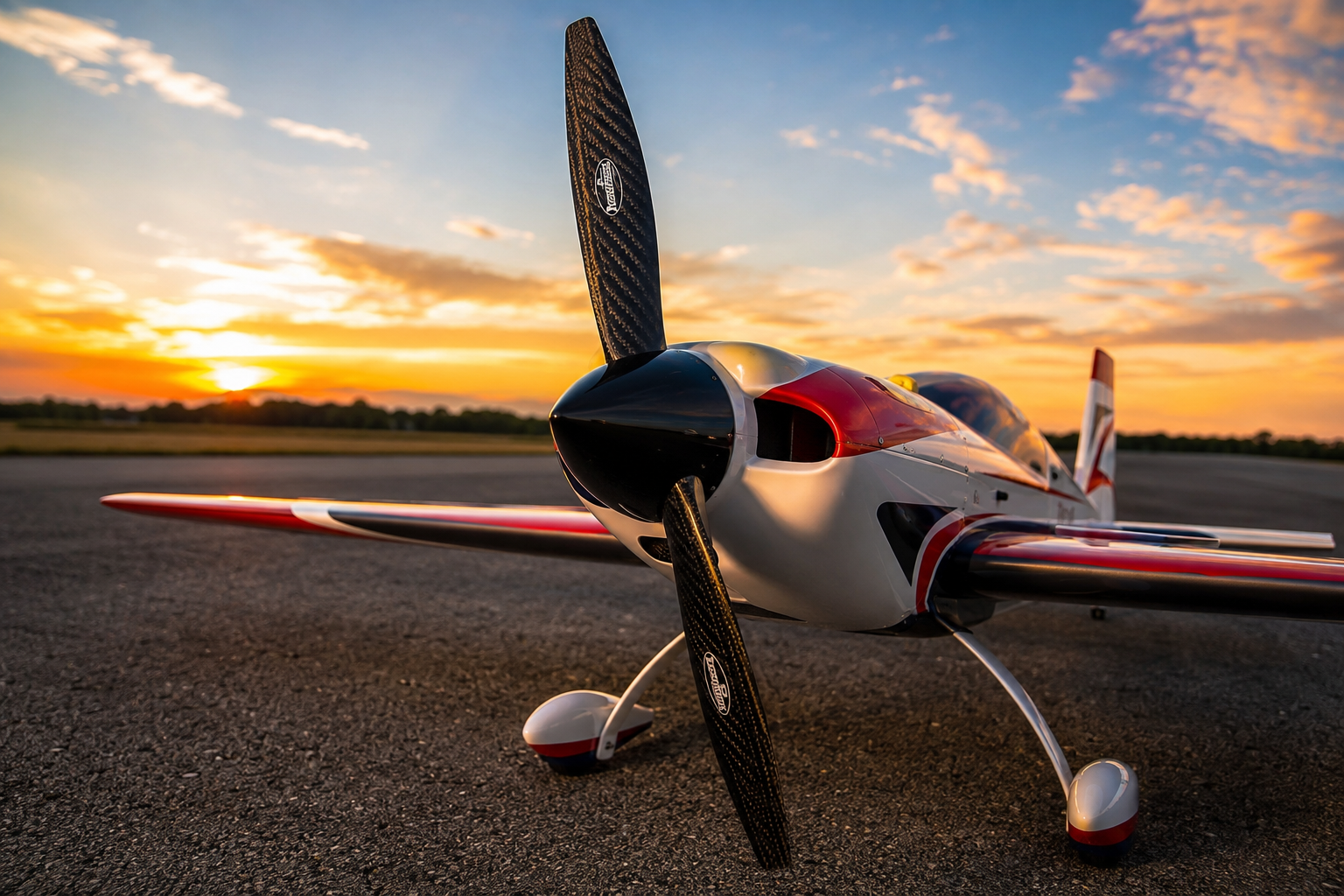
A propeller may be one of the least expensive components on an RC airplane, but few parts have greater influence over how the model performs. Change the propeller, and you can change the airplane’s acceleration, climb rate, top speed, throttle response, flight time, motor temperature, noise, and even the way it feels during landing approaches.
That is because the propeller is where engine or motor power finally becomes useful work. The battery, ESC, motor, fuel system, and engine can create power, but the propeller decides how that power is transferred into the surrounding air.
A well-matched propeller makes an airplane feel strong, smooth, and efficient. A poor match can make the same model feel weak, noisy, overheated, or strangely difficult to fly. In extreme cases, an incorrect propeller can destroy a motor, damage an ESC, over-stress a battery, or cause an engine to fail in flight.
Propeller choice changes everything because the propeller is not simply attached to the power system. It is the load that defines how the power system operates.
Diameter: How Much Air the Propeller Moves
The first number in a propeller designation is its diameter. A 12 x 6 propeller, for example, has a diameter of 12 inches.
Diameter has a major effect on thrust because it determines the size of the circular disc swept by the blades. A larger-diameter propeller moves a greater mass of air. This often produces stronger low-speed thrust, better acceleration, and improved climbing ability.
That makes larger propellers attractive for trainers, aerobatic airplanes, bush-style models, and aircraft that need strong pull at relatively low speeds.
However, increasing diameter also increases the load on the motor or engine. The blade tips travel faster, the propeller encounters more aerodynamic resistance, and the power system must work harder to maintain rpm.
This is why increasing diameter by only one inch can produce a surprisingly large increase in current draw on an electric model. It is also why a larger propeller may cause a glow or gasoline engine to turn below its intended operating range.
Physical clearance matters as well. The propeller must clear the ground during takeoff, landing, and taxi operations. Taildraggers can lose clearance as the tail rises. Tricycle-gear models may flex their nose gear during a firm arrival. A propeller that appears safe while the airplane is sitting still may strike the runway under load.
Pitch: How Far the Propeller Tries to Advance
The second number describes pitch. In theory, a 12 x 6 propeller attempts to move forward six inches during one revolution, much like a screw advancing through a solid material.
Real propellers operate in air, so they never travel their full theoretical pitch distance. Air slips, bends, accelerates, and moves around the blades. Even so, pitch remains a useful indication of the propeller’s intended behavior.
A lower-pitch propeller generally provides stronger acceleration, better braking, and improved climb at lower airspeeds. It allows the motor or engine to reach rpm more easily and is often a good choice for trainers, slow-flying models, and aircraft that spend much of the flight maneuvering.
A higher-pitch propeller attempts to move the airplane farther forward with each revolution. This can improve top speed, especially when the aircraft, motor, and available power are suited to the additional load.
The common mistake is assuming that more pitch always creates more speed.
A high-pitch propeller that prevents the motor or engine from reaching an effective rpm may actually make the airplane slower. Acceleration suffers, climb performance declines, and the power system may generate excessive heat. The propeller is trying to take too large a bite of air for the available torque.
The fastest propeller is not necessarily the one with the greatest pitch. It is the one that allows the complete power system to operate efficiently while matching the airplane’s drag and intended speed range.
Diameter and Pitch Must Be Considered Together
Propeller dimensions are not independent settings. Diameter and pitch work together to determine the total load.
A 12 x 6 propeller and an 11 x 8 propeller may both be reasonable choices for a particular motor, but they will give the airplane different personalities. The 12 x 6 may provide stronger pull, better climb, and more confident low-speed performance. The 11 x 8 may produce less static thrust but greater speed once the airplane is moving.
Neither is automatically better.
The correct choice depends on the aircraft. A high-wing trainer benefits from predictable thrust and moderate speed. A sleek sport airplane may perform better with a smaller-diameter, higher-pitch propeller. A 3D model needs immediate thrust and strong control authority at low forward speed. A scale warbird may require a compromise among speed, ground clearance, sound, and appearance.
Propeller selection should begin with the aircraft’s mission, not with the desire to install the largest or fastest-looking propeller available.
Blade Count Is More Than a Scale Decision
Two-blade propellers are widely used because they are generally efficient, lightweight, affordable, and easy to balance. For many RC airplanes, a two-blade propeller provides the best overall performance.
Three-blade and four-blade propellers are often chosen for scale appearance, additional ground clearance, or the ability to absorb power within a smaller diameter.
Adding blades, however, increases aerodynamic load. A three-blade propeller of the same diameter and pitch as a two-blade propeller will usually draw more current or reduce engine rpm.
When converting from two blades to three, pilots commonly reduce diameter and sometimes pitch. The exact adjustment depends on blade shape, manufacturer, motor characteristics, and aircraft requirements. There is no universal conversion formula that works perfectly in every situation.
More blades can improve thrust within a limited diameter, but the additional blade area and aerodynamic interaction may reduce peak efficiency. The decision should be based on the complete aircraft rather than appearance alone.
On Electric Models, the Propeller Controls Current
Electric power systems make propeller testing easy, but they also make improper propeller selection dangerous.
The propeller is the primary load on the motor. Increase diameter, pitch, blade area, or blade count, and the motor must produce more torque. Producing more torque generally requires more current.
That additional current flows through the battery, connectors, wiring, ESC, and motor windings. If any component is pushed beyond its rating, heat builds rapidly.
A motor may appear to spin a large propeller without difficulty during a brief bench test, but that does not mean the combination is safe. The motor could be drawing far more current than its continuous limit. The ESC may be operating near shutdown temperature. The battery may be experiencing excessive voltage sag.
A wattmeter is one of the most valuable tools an electric pilot can own. It reveals voltage, current, and power while the system is operating. These readings can be compared with the limits of the motor, ESC, and battery.
Testing should be conducted with a fully charged battery, because that is when voltage and potential power are highest. The model must be securely restrained, and everyone must remain clear of the propeller arc.
A propeller change that appears minor can push a previously safe system beyond its limits. Measure rather than guess.
Glow and Gas Engines Need the Right Load Too
Internal-combustion engines also depend on correct propeller loading.
An oversized or overly aggressive propeller can prevent an engine from reaching its intended power band. The engine may sound labored, accelerate slowly, run hot, and struggle during vertical maneuvers.
A propeller that is too small may allow excessive rpm. The engine may sound impressive, but the airplane can lack useful thrust. Excessive rpm can also increase wear and mechanical stress.
Engine manufacturers usually provide a recommended propeller range. That range is the correct starting point. Final selection can then be adjusted for break-in status, fuel, muffler type, altitude, aircraft style, and desired performance.
Tachometer readings are useful, but they should be considered alongside throttle response, engine temperature, flight performance, and reliability. The goal is not merely to achieve a particular rpm. The goal is to create a combination that allows the engine to operate consistently throughout the flight.
Match the Propeller to the Type of Flying
Different aircraft place different demands on a propeller.
A trainer benefits from strong static thrust, moderate pitch speed, smooth acceleration, and dependable low-speed control. A large-diameter, moderate-pitch propeller is often appropriate.
A sport airplane may benefit from a balanced combination that provides both climb and speed. Pilots can fine-tune the model toward acceleration or top-end performance by adjusting diameter and pitch within safe limits.
A warbird often needs speed, but it may also have limited ground clearance. A smaller-diameter, higher-pitch propeller or a multiblade design may provide a useful compromise.
A 3D airplane needs immediate thrust at low airspeed. Large-diameter, lower-pitch propellers are common because they move a large volume of air and provide strong response during hovering and post-stall maneuvers.
Electric gliders often use folding propellers. These must be matched not only for power but also for spinner diameter, blade clearance, folding direction, and safe hub operation.
Multiengine airplanes require additional care. Propellers should be closely matched, and both power systems should produce similar thrust. Counter-rotating propellers may improve handling, but rotation direction, nut security, and propeller availability must all be considered.
Material and Blade Shape Matter
Two propellers with identical diameter and pitch markings may not perform the same.
Blade width, airfoil section, tip shape, stiffness, hub design, and material all influence load and efficiency.
Wood propellers are light and often respond quickly to throttle changes. Composite and reinforced nylon propellers are durable and widely available. Carbon-fiber propellers can be extremely stiff and efficient, but their stiffness can increase load and their sharp edges demand careful handling.
Flexible blades may flatten or twist under load, effectively changing pitch during operation. Stiffer blades tend to hold their intended shape, which can improve consistency but may also increase current draw compared with a more flexible propeller of the same marked size.
Propeller brand and design should therefore be treated as part of the specification. A safe test with one 13 x 6 propeller does not guarantee identical results with every 13 x 6 propeller.
Balance and Installation Are Part of Performance
Even the correct propeller will perform poorly if it is unbalanced or installed incorrectly.
An unbalanced propeller creates vibration that can damage bearings, loosen fasteners, fatigue motor mounts, disturb electronic components, and produce misleading sound. Severe vibration also wastes energy and can shorten the life of the entire airframe.
Both blades should balance equally, and the hub should be checked for side-to-side imbalance. Material should be removed carefully from the heavy blade, or a suitable finish may be added to the light blade when appropriate.
The propeller must face the correct direction. The printed or molded markings usually face forward, toward the direction of travel. Installing a propeller backward may still produce thrust, but performance will be dramatically reduced because the blade airfoil is operating incorrectly.
Inspect the hub and blades before every flying session. Any propeller with cracks, deep nicks, stress marks, damaged roots, or evidence of a ground strike should be replaced. A propeller is never the place to gamble on hidden damage.
A Better Way to Test Propellers
Begin with the motor, engine, or aircraft manufacturer’s recommendation.
Record the propeller size, battery type, voltage, current, watts, rpm if available, flight time, and component temperature. Then evaluate actual flight performance.
Does the airplane accelerate cleanly? Does it climb without excessive throttle? Is full throttle useful, or does the sound increase without a matching increase in speed? Are the motor, ESC, battery, or engine unusually hot after landing?
Change only one variable at a time. Moving from a 12 x 6 to a 13 x 8 changes both diameter and pitch, making it difficult to understand which change produced the result.
A good testing sequence might compare a 12 x 6 with a 12 x 7, then compare the preferred choice with an 11 x 8. Each step should remain within the approved operating range.
The best propeller is not always the one that produces the highest wattage, rpm, or top speed. It is the propeller that delivers the desired flight characteristics without excessive stress, heat, noise, or energy consumption.
Final Approach
A propeller functions much like the transmission and tires of a full-scale vehicle. It determines how available power is applied to the task.
Choose correctly, and the airplane becomes more responsive, efficient, reliable, and enjoyable. Choose poorly, and even an excellent motor or engine can feel disappointing.
Propeller selection is not mysterious, but it deserves respect. Begin with trusted recommendations, understand diameter and pitch, measure electrical load, watch engine rpm, inspect every blade, and test methodically.
The propeller may be the simplest moving part on the airplane, but it is the final link between power and flight. That is why changing it can change everything.
Have Questions?
Contact us about visiting the field, learning to fly, upcoming events, or club membership. We look forward to connecting with you.